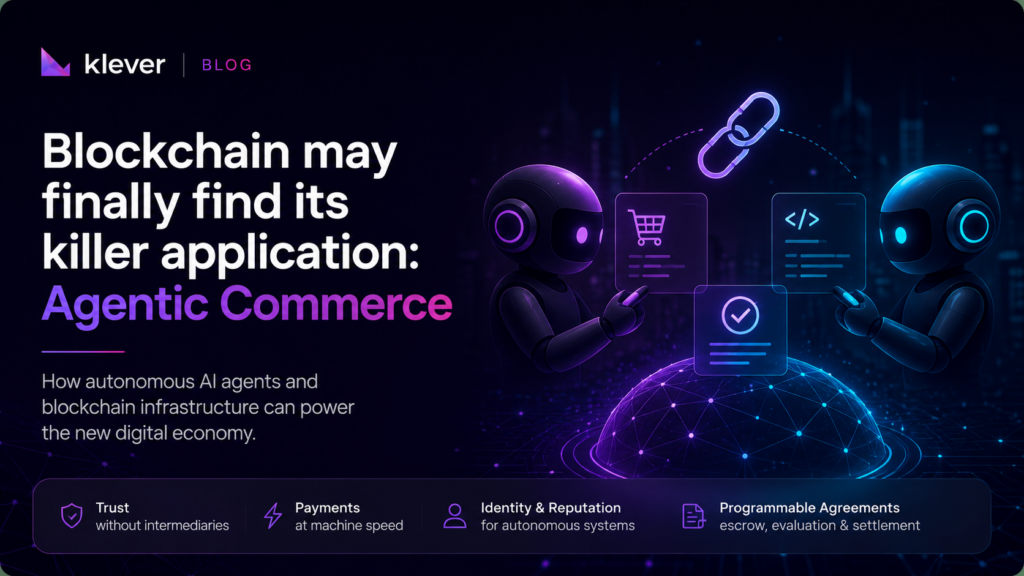
For years, the blockchain industry has searched for its “killer application.”
We started with cryptocurrencies. Then came DeFi, NFTs, DAOs, meme coins, tokenization, and many other narratives.
Each contributed something valuable.
But I believe the next wave may be fundamentally different.
Autonomous AI agents.
What Is Agentic Commerce?
Imagine an AI agent planning your business trip.
It compares flights, books hotels, purchases travel insurance, reserves a coworking space, pays for APIs, negotiates services, and coordinates everything without human intervention.
No one clicks “Confirm.”
That is what agentic commerce means: autonomous software agents discovering services, agreeing on terms, paying, and settling with each other — without a human approving each step.
Now imagine that every service involved belongs to a different company, operates in a different jurisdiction, and has no pre-existing trust relationship with the others.
How do these agents:
- Discover trustworthy service providers?
- Verify reputation?
- Negotiate commercial terms?
- Lock payments while work is being performed?
- Evaluate outcomes and resolve disputes?
- Settle transactions automatically?
This is where blockchain becomes much more interesting—not as the product, but as the infrastructure.
Just as the Internet standardized how computers exchange information, blockchain can help standardize how autonomous agents establish trust and execute commerce.
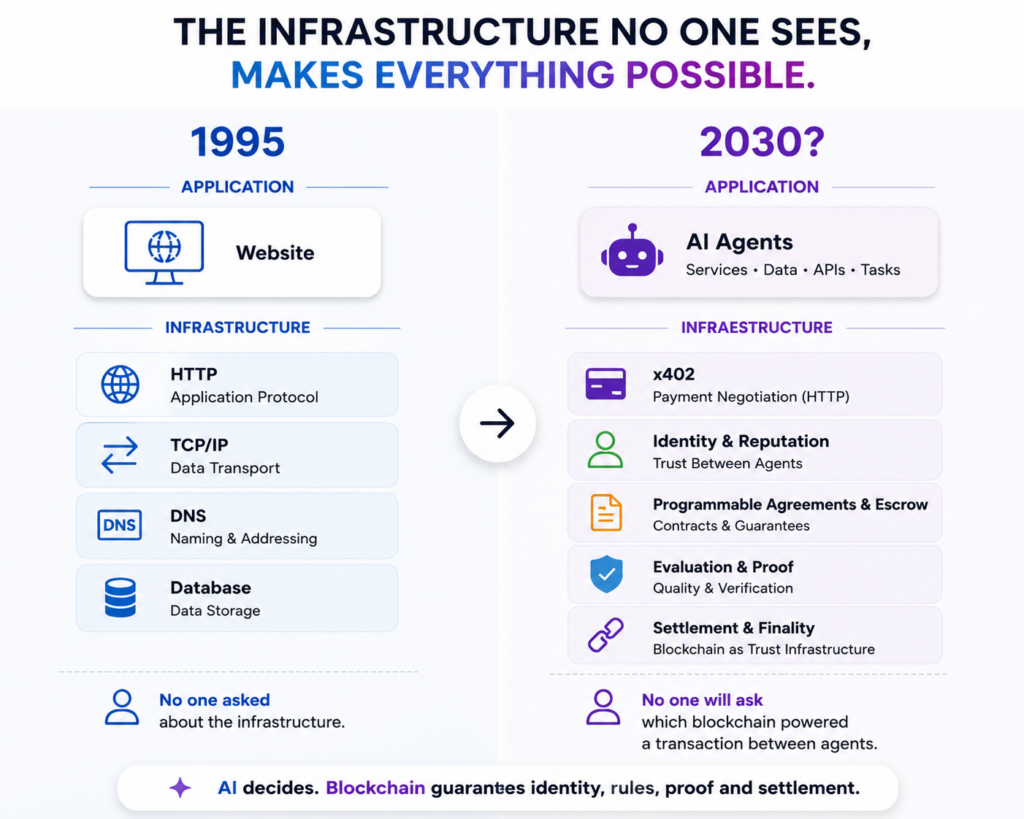
Payment protocols such as x402 may provide an HTTP-native interface for machine-to-machine payments, allowing agents to pay for APIs, datasets, and digital services.
But payment is only one part of the problem.
Agents also need identity, reputation, programmable agreements, escrow, evaluation, and settlement.
Those capabilities can allow autonomous systems with no previous relationship to transact under transparent rules without depending entirely on a centralized intermediary.
In that world, blockchain does not replace AI.
It complements AI.
AI makes decisions.
Blockchain provides trust infrastructure.
Building the Foundation for the New Digital Economy
This vision is also shaping how we think about the future of Klever Blockchain.
From the beginning, our goal has not been simply to build another Layer 1. It has been to build the foundation for the new digital economy: infrastructure that developers and businesses can rely on without exposing blockchain’s complexity to end users.
That requires more than smart-contract execution alone. It requires predictable costs, strong security, accessible development tools, interoperability, and infrastructure designed for increasingly autonomous digital interactions.
Preparing for the Autonomous Economy
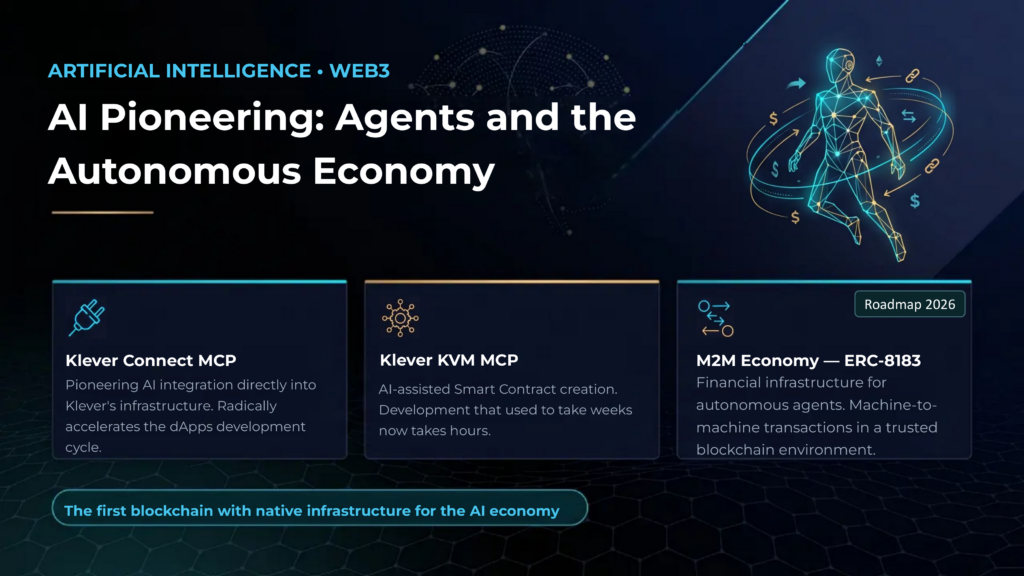
The Klever Blockchain roadmap reflects this direction.
We are building native AI integration through Klever Connect MCP and enabling AI-assisted smart-contract development with Klever VM MCP.
We are also preparing the foundations for a machine-to-machine economy through ERC-8183-compatible commercial agreements. Looking further ahead, we envision support for decentralized identity, reputation, programmable agreements, escrow, evaluation, and autonomous settlement—building blocks for an economy in which AI agents can discover, negotiate, collaborate, and transact more safely.
These components belong to different layers of the emerging stack:
- AI agents make decisions and coordinate work.
- Protocols such as x402 negotiate payments at the HTTP layer.
- Agent-commerce standards define identity, reputation, agreements, and evaluation.
- Klever Blockchain provides programmable execution and settlement.
Not every agent interaction will require every layer. A simple paid API request may need only payment negotiation and settlement. A complex task performed over time may require identity, escrow, evaluation, and reputation as well.
The objective is not to force every interaction into one protocol. It is to provide interoperable infrastructure from which developers can choose the guarantees their applications require.
The Invisible Blockchain
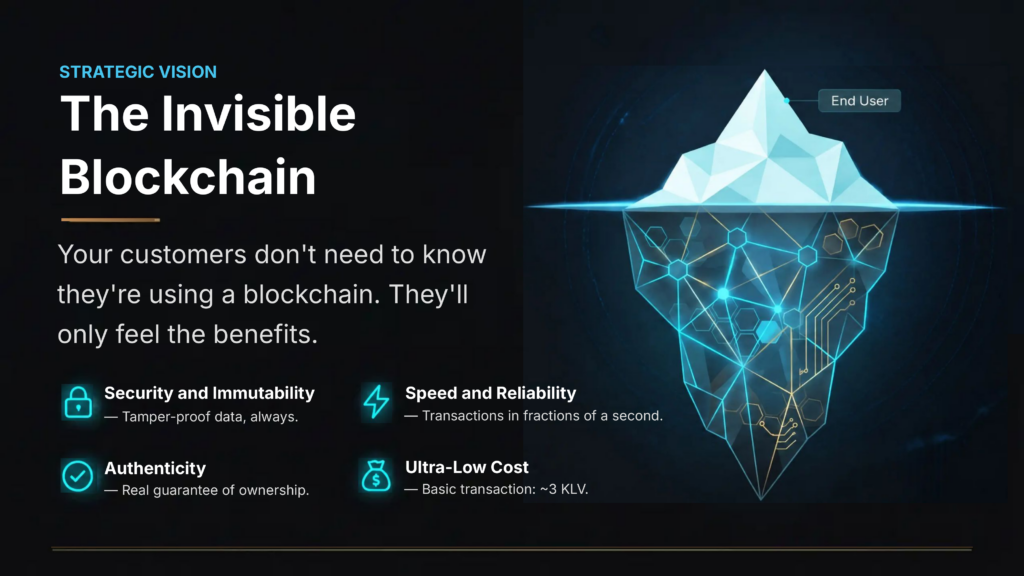
The long-term objective is not to make blockchain more visible.
It is exactly the opposite.
Users should not need to know which blockchain processed a transaction between autonomous agents, just as they rarely know which database powers the applications they use every day.
That is why one of our core principles is The Invisible Blockchain: technology that quietly provides security, authenticity, speed, and trust while remaining invisible to the people benefiting from it.
There is still significant work ahead. Reliable agent commerce will require more than optimistic claims of “trustlessness.” Reputation must resist manipulation. Evaluators must be trustworthy or verifiable. Escrow and dispute mechanisms must reflect the risks of the services being exchanged. Security must remain a prerequisite, not an afterthought.
But the direction is becoming clearer.
Perhaps blockchain’s real destination is not to become the product.
Perhaps it is to become the infrastructure that powers the autonomous economy.