Interoperability is a core requirement for modern blockchain ecosystems. Users and applications increasingly operate across multiple networks, while liquidity and assets remain distributed across different chains.
The Klever Ethereum Bridge was designed to address this reality by enabling secure, decentralized, and non-custodial transfers between Klever Blockchain and Ethereum, without relying on centralized intermediaries. This article provides a technical overview of the bridge architecture, transfer mechanisms, and incentive model.
Architecture: A Decentralized Relayer Network
At the core of the Klever Ethereum Bridge is a decentralized network of nodes known as relayers. These relayers are responsible for monitoring events on both blockchains and validating cross-chain transfers.
No Central Authority
Relayers do not custody user funds, private keys, or assets. Their role is limited to validation and consensus. Assets are held exclusively by Safe smart contracts deployed on their respective blockchains.
Multisignature Consensus
All bridge operations are governed by multisignature smart contracts. For any transfer to be executed, a predefined quorum of authorized relayers must agree on the validity of the transaction.
This model ensures that no single participant can execute or manipulate transfers independently.
Proof-of-Stake Security
Relayers operate under a Proof-of-Stake (PoS) model. Participation requires staking KFI tokens, which act as economic collateral. Any attempt to validate fraudulent transactions or manipulate bridge state can result in slashing, where staked tokens are seized through a consensus-based process.
Cross-Chain Transfer Mechanism
Blockchains were not originally designed to communicate with one another. The Klever Ethereum Bridge introduces a decentralized interoperability layer that enables asset transfers using mechanisms adapted to each network’s permissions and standards.
Token Standards
- Klever Blockchain: KDA (Klever Digital Assets)
- Ethereum: ERC-20 standard
⠀
Native Token Transfers
The bridge applies different strategies depending on the token’s origin chain.
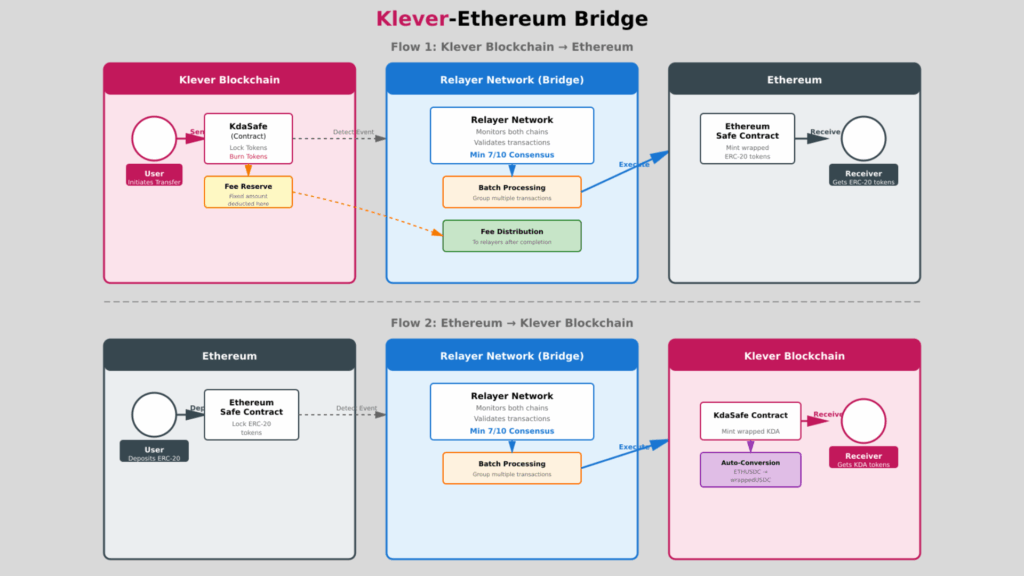
Native Klever tokens → Ethereum
- Tokens are locked in a Safe contract on Klever Blockchain
- Equivalent wrapped tokens are minted on Ethereum
⠀
Native Ethereum tokens → Klever Blockchain
- ERC-20 tokens are locked in a Safe contract on Ethereum
- Equivalent wrapped tokens are minted on Klever Blockchain
Wrapped Token Handling
When assets are transferred from Ethereum to Klever Blockchain, the bridge follows a two-step process:
- A prefixed wrapped token (for example, ETHUSDC) is minted on Klever Blockchain, representing the asset locked on Ethereum
- This token is automatically converted into the standard wrapped asset format on Klever Blockchain
⠀
This process preserves transparent accounting of token origin while maintaining 1:1 parity with locked assets. No additional user interaction is required after initiating the transfer.
Purpose and Ecosystem Impact
The Klever Ethereum Bridge is designed to bring external assets into the Klever ecosystem, where users and applications can benefit from:
- Lower transaction fees
- High performance and scalability
- Full compatibility with the Klever Virtual Machine (KVM)
⠀
Once represented as KDA assets, bridged tokens can participate in DeFi protocols, swaps, staking systems, and other on-chain activities within the Klever ecosystem.
Technical Stack
The bridge is implemented using an open-source, multi-language architecture.
- Rust (Klever smart contracts)
Manages KDA Safe logic, deposits, withdrawals, and bridge state on Klever Blockchain - Solidity (Ethereum smart contracts)
Controls the Safe contract on Ethereum, handling token locking and releasing through a lock-and-release model - Go (Relayer nodes)
The klv-bridge-eth-go service coordinates relayer operations, consensus, and synchronization across both blockchains
⠀
Fee Structure
The Klever Ethereum Bridge applies a directional fee model:
- Klever Blockchain → Ethereum
A portion of the transferred amount is reserved to cover execution and relayer costs - Ethereum → Klever Blockchain
No additional bridge fees are charged. Users pay only standard Ethereum gas fees
⠀
This model encourages inbound liquidity while aligning relayer incentives with actual bridge usage.
Transfer Flows
Klever Blockchain → Ethereum
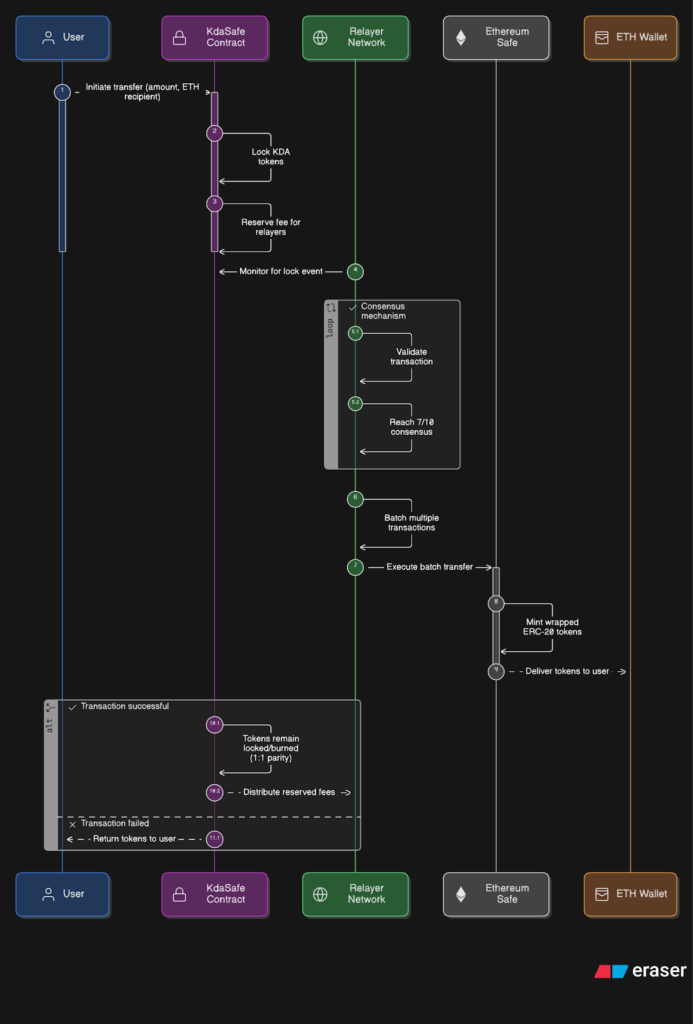
- The user initiates a transfer via the KDA Safe contract on Klever Blockchain
- Tokens are locked in the Safe contract
- A fee reserve is set aside for relayer compensation
- Relayers detect the lock event
- Consensus is reached
- Transactions may be batched for efficiency
- Relayers execute the transfer on Ethereum
- Wrapped ERC-20 tokens are minted and delivered
⠀
If execution fails, tokens are returned to the user. If successful, reserved fees are distributed to relayers.
Ethereum → Klever Blockchain
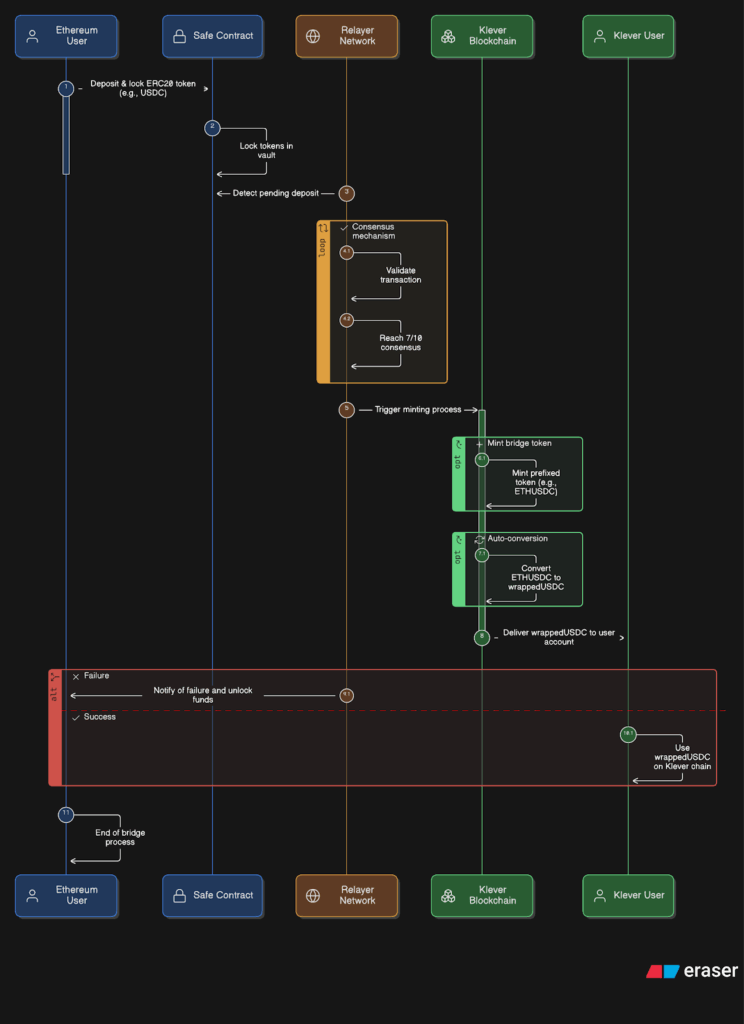
- The user locks ERC-20 tokens in the Ethereum Safe contract
- Relayers monitor the Ethereum blockchain
- Consensus is reached
- Wrapped tokens are minted on Klever Blockchain
- Assets are delivered to the user’s Klever account
⠀
Incentives and Security Model
The bridge aligns incentives with security through two complementary mechanisms.
Transaction-Based Rewards
Relayers earn fees from completed bridge transactions. Rewards are directly tied to bridge usage and transaction volume, rather than time-based emissions.
Proof-of-Stake Slashing
All relayers stake KFI tokens. Malicious behavior triggers slashing through relayer consensus, ensuring accountability and long-term network integrity.
For users, this results in:
- A non-custodial bridge model
- Transparent execution
- Lower transaction costs once assets are on Klever Blockchain
⠀
Conclusion
The Klever Ethereum Bridge provides a practical and secure approach to cross-chain interoperability. By separating validation from custody, enforcing multisignature consensus, and aligning incentives through staking and transaction-based rewards, the bridge minimizes trust assumptions while remaining efficient and usable.
This infrastructure strengthens Klever’s position in a multi-chain ecosystem, enabling assets to move securely between Ethereum and Klever Blockchain while supporting long-term growth across DeFi, applications, and on-chain activity.
Start using the Klever Ethereum Bridge
- Access the bridge: https://bridge.klever.org
- Verify transparency: https://bridge-proof.klever.org
- Connect using Klever Wallet or the Klever Extension
- Read the Announcement details: https://klever.org/blog/klever-ethereum-bridge-launch/